
Bring back Exams
- Tim Boatswain

- Apr 26
- 5 min read
Updated: May 3
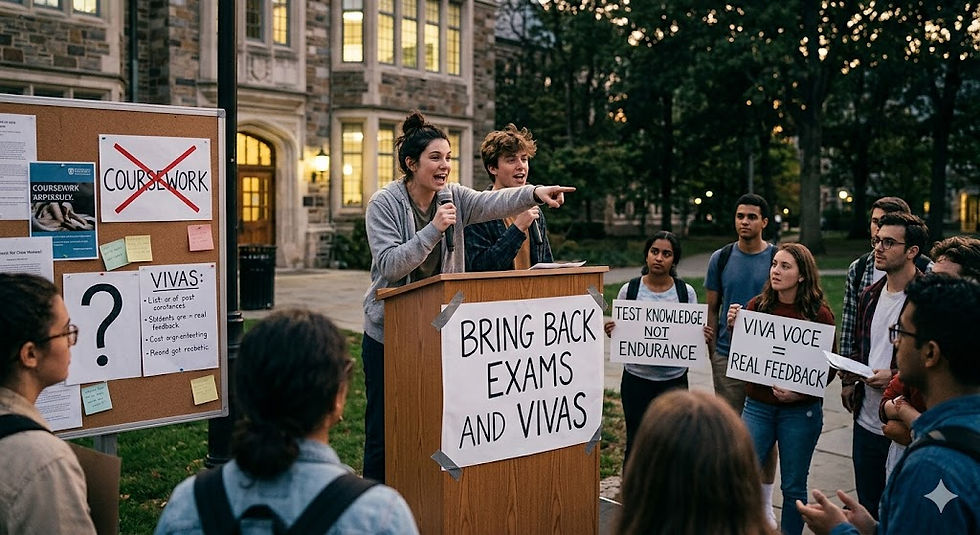
I can remember 40-odd years ago, as a humble university lecturer, spending a lot of time checking whether undergraduate essays had been plagiarised. At that time, universities were moving their systems of assessment towards more coursework away from traditional examinations. Later, the COVID-19 pandemic catalysed a significant acceleration in this transition; the underlying motives can be seen as related to a pedagogical philosophy, which claimed a move to equity and student well-being.
One significant argument for coursework rather than tests and examinations is its ability to promote deeper learning. Unlike a high-stakes final exam, which can be seen as incentivising short-term cramming, coursework allows students to engage with a subject over an extended period. This can facilitate what educators call "authentic assessment," where tasks mirror real-world challenges. Students have the opportunity to develop long-term research projects, analyse case studies, or create portfolios and presentations. This approach is seen as developing vital skills such as critical analysis, problem-solving, and project management, which are often difficult to assess in a timed exam setting.
Another argument relates to a key pedagogical shift from summative assessment (assessment of learning) to formative assessment (assessment for learning). Coursework allows for continuous feedback loops, where students can improve their work based on tutor input before final submission. This continuous engagement is designed to enhance understanding rather than just measure recall.
Traditional exams are often criticised for testing a student's ability to perform under extreme pressure rather than their true understanding of the subject matter. Students frequently report that exam anxiety negatively impacts their performance, and critics argue that this format can disadvantage certain groups, particularly females, perpetuating achievement gaps.
Coursework, it is claimed, can be perceived as a more inclusive and flexible form of assessment. It allows students to work at their own pace, manage their time, and demonstrate their knowledge without the intense time constraints of an exam hall. As expected, research confirms that students generally have a strong preference for coursework over exams and that this preference often correlates with higher levels of student satisfaction.
The Covid pandemic served as a major external shock to the whole education system. Lockdowns made in-person exams logistically impossible, forcing institutions to rapidly adopt alternative assessments. Not surprisingly, studies show that this shift often resulted in higher final grades compared to exam-based models. The considerable increase in top grades seen over the past decade is partly attributed to the rise of coursework assessment. While proponents argue that coursework provides a fairer reflection of a student's ability, this trend has also raised concerns about maintaining academic standards with an increase in plagiarism and "grade inflation".
However, the most recent and urgent concern for change is the advent of generative AI, which has transformed the landscape of academic integrity. Tools like ChatGPT, Claude, etc. make traditional take-home essays vulnerable to contract cheating and AI-generated submissions, prompting universities to attempt to "AI-proof" their assessments. Consequently, institutions need to diversify their methods to include in-class presentations, vivas (oral exams), and project-based assessments conducted under supervised conditions to ensure that the work is genuinely the student's own.
Although the move to coursework aimed to create more relevant, engaging, and equitable learning experiences, it has brought challenges related to maintaining rigour, ensuring consistent standards across different assessment types, and, crucially, preserving academic integrity in an age where AI can easily replicate traditional written tasks.
Of course, I belong to the ‘old guard’, and I was never convinced that making life ‘easier’ for the student enhanced learning or created more ‘authentic’ assessments. Further, to my old fogey grumpiness, I have not been surprised by recent research on Generation Z (born 1997–2012) - the first truly "digital native" generation. There is some data which reveals an alarming paradox. Gen Z has achieved higher levels of formal education, but there are measurable declines in certain cognitive skills and deep literacy compared to previous generations.
Academic metrics tell a startling story. Neuroscientist Jared Cooney Horvath presented data before the U.S. Senate showing that Gen Z is the first generation in modern history to score lower on standardised academic tests than the previous generation. The decline cuts across multiple cognitive domains, including attention, memory, literacy, numeracy, executive function, and general IQ. This pattern appears internationally, with data from over 80 countries showing declining academic performance correlating with widespread adoption of digital technology in classrooms.
And here is the paradox: statistics also indicate that Gen Z is on track to be the best-educated generation in terms of formal credentials, with higher rates of tertiary education enrollment and lower dropout rates than Millennials and Gen X. This apparent contradiction reflects a crucial distinction: more credentials, degrees. diplomas and certificates do not necessarily mean better cognitive development or deeper learning.
The primary explanation offered by researchers centres on technology's impact on learning habits. Horvath testified that teenagers now spend more than half their waking hours staring at screens, which has fundamentally altered how they engage with information. Surveys show that 35% of Gen Z students dislike reading, and 43% rarely or never read for fun. Reading scores on the 2024 National Assessment of Educational Progress fell for school students, continuing a decline that predates pandemic disruptions.
The educational environment has also shifted. Schools have spent enormous sums on educational technology, but neuroscientists argue that digital learning often turns students into "skimmers" rather than deep thinkers. It is argued that humans are biologically programmed to learn from other humans and from sustained engagement with challenging material, not from scrolling through bullet-point summaries.
The COVID-19 pandemic exacerbated these challenges by disrupting social development and forcing prolonged reliance on remote learning. Gen Z's socialisation process was massively interrupted at a critical developmental stage, and many report feeling unprepared for the "real world" in terms of soft skills like resilience, collaboration, and communication.
Educators report that students are increasingly submitting assignments written by language models, even when they struggle to explain what the content means. The concern here isn't just plagiarism; it's the missing intellectual effort. Without forming ideas independently, students lose the chance to test, revise, and internalise knowledge.
Significantly, many young people recognise these gaps themselves. Survey research indicates that 68% of Gen Z respondents believe they could function in their jobs without their college degrees, and 51% said their degree was a waste of money. One Oxford graduate noted that her school had not taught her to think for herself or reflect on her learning, creating a "culture shock" at university.
This does not mean Gen Z is incapable or unintelligent. Rather, it suggests that the skills being measured and the environments in which learning occurs have changed. The challenge facing educators and policymakers is whether education systems can adapt to develop the deep thinking, creativity, and resilience that Gen Z itself says it wants and needs. I do believe assessments that revert to tests, exams and vivas could be part of a solution, as lecturers would engage with an individual's understanding and not with the latest AI tool.


Comments