
The Healer of St Albans: Restoring the Grave of a Mental Health Visionary
- Tim Boatswain
- Jun 4
- 4 min read
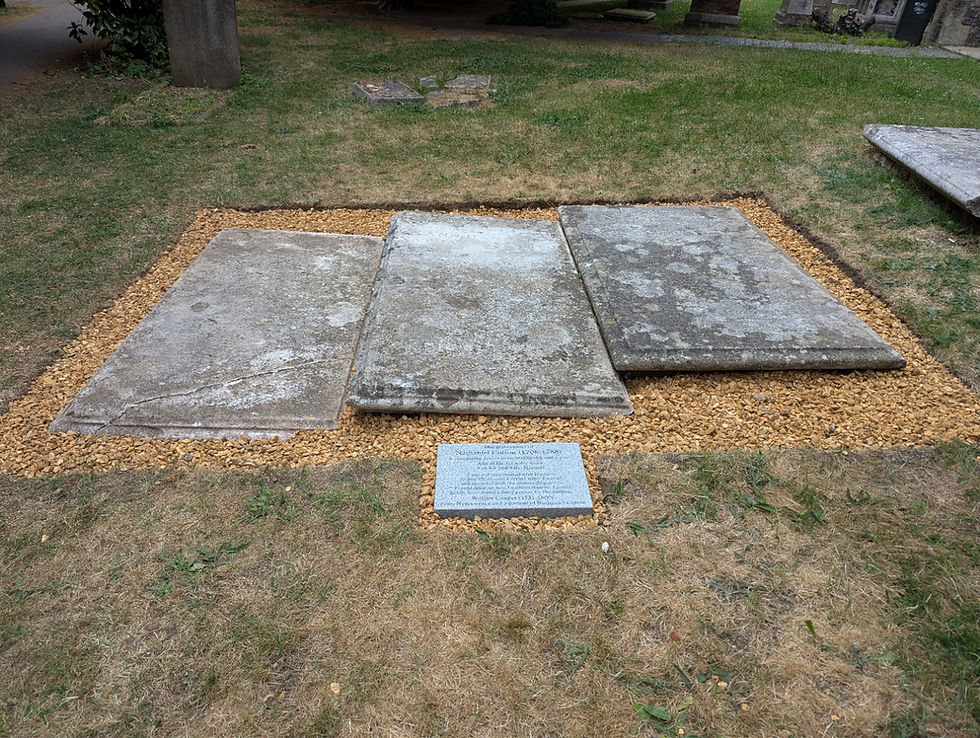
Under a gentle midday sun on Monday, 1st June 2026, a good turnout gathered in the historic grounds of St Peter's Churchyard for the dedication of a newly renovated monument: the gravestones of Nathaniel Cotton and those of his two wives, Anne Pembroke and Hannah Everett.
Yet the atmosphere suggested something more significant than a simple repair. This was a long‑overdue act of gratitude for Dr Nathaniel Cotton, an 18th‑century physician whose radical kindness changed the trajectory of psychiatric medicine. It was also wonderful that several of his descendants had travelled a considerable distance to attend.
The ceremony was presided over by Professor Tim Boatswain, Chair of Conservation 50, who initiated the renovation. The guest of honour, the Right Reverend Dr Jane Mainwaring, Bishop of Hertford, was sadly unwell, but her place was taken by the Archdeacon of St Albans, Charles Hudson. Speeches were made by Dr Florian Ruths, who explained Cotton's importance in the treatment of mental illness. The Mayor, Cllr Matt Fisher, on his first engagement since his inauguration, spoke of Cotton's significance to the city. The Archdeacon of St Albans and the Vicar of St Peter's, Mark Dearnley, referred to Cotton's firm religious belief and moral uprightness.
For years, these gravestones had sat neglected, the inscription on the central stone virtually illegible after two centuries of Hertfordshire rain – a fading tribute to a man whose legacy remains embedded in the very geography of the city.
To understand the importance of this renovation, one must look back to the mid‑1700s, an era when "madness" was viewed with a mixture of fear and derision. In London, the notorious Bethlem Royal Hospital, which was popularly known as "Bedlam", treated the mentally ill as spectacles for public entertainment. Patients were frequently chained, subjected to "purging" treatments, and housed in squalid, unheated cells.
Dr Cotton, however, envisioned a different path. In the heart of St Albans, he established the Collegium Insanorum (College for the Insane). Located at the junction of what is now College Street and Lower Dagnall Street, the institution was revolutionary. Its very name, which lives on in the modern street signs, reflected Cotton's belief that his facility should be a place of learning and recovery, not a prison.
At a time when clinical psychology was in its infancy, Cotton pioneered what he termed "moral therapy". He rejected the use of shackles and violence, opting instead for a regimen of dignity, conversation and a peaceful environment. He famously cared for the poet William Cowper, who arrived at the asylum in the depths of suicidal despair and left eighteen months later, crediting Cotton's "gentle and Christian treatment" with his recovery. As part of the renovation, an inscription with Cowper's words praising Nathaniel Cotton's treatment now adorns the Cotton family burial place.
Despite his professional fame, Cotton was an intensely private man. He balanced his medical duties with the writing of popular poetry, yet little of his personal correspondence survived. When he died on 2nd August 1788, he was buried in St Peter's Churchyard, having served the community for decades.
Over the last half‑century, however, the physical memory of Cotton began to crumble. The family gravestones had fallen into such disrepair that many passers‑by were unaware they were walking past the grave of one of the most important figures in the history of British mental medicine. The inscriptions had become entirely illegible, and the stones themselves were deteriorating.
The effort to save the monument was a voluntary endeavour that bridged academia and the local community. A unique partnership spearheaded the project: Professor Tim Boatswain, an anthropologist, and Dr Florian Alexander Ruths, a contemporary psychiatrist. Together with the support of St Peter's Church, they launched a series of public lectures exploring the intersection of anthropology and modern psychiatry in understanding human emotions.
These talks served a dual purpose: they educated a new generation of St Albans residents about the "Doctor of Kindness" in their midst, and they raised the funds required for a professional restoration. The community response was very positive, proving that Cotton's message of empathy still resonates in the 21st century.
The technical challenge of the renovation was met by Burgess Memorials, a local firm that volunteered its expertise to ensure the stones were preserved using historically appropriate techniques. Their craftsmen worked to stabilise the bases and carefully, gently, cleaned the gravestones, so as not to disturb the lichen, but to remove the moss. As a result, the names of Nathaniel, Anne and Hannah can now be read, ensuring that their names would not be lost to neglect.
As the ceremony drew to a close, Tom Cotton, a fifth-generation descendant of Nathaniel Cotton, gave gracious thanks for the renovation and the ceremony: an occasion that carried both spiritual and moral weight.
Earlier, it had been noted that while medical science has advanced immeasurably since 1788, the fundamental need for "moral therapy”, which is the simple act of seeing the person behind the diagnosis, is more relevant today than ever. "Dr Cotton did not just treat the mind; he cared for the soul," the Mayor told the assembled guests, and "By restoring these stones, we are not just honouring a man from the past. We are reaffirming our city's commitment to the values he championed: compassion, patience, and the recognition of our shared humanity."
The renovation follows the installation of a blue plaque at the site of Cotton's former asylum in 2022, further cementing St Albans' status as a landmark in the history of mental health reform. As the ceremony concluded and the guests dispersed, the newly renovated gravestones caught the light. It was a clear, permanent reminder that in the history of St Albans, kindness has always left its mark.


Comments