
A Journey to Worms
Commemorating Tyndale's Bible and the Power of the Printed Word
A personal account of the 2026 Quincentenary Events in Worms, Germany
When my colleague, Dr Florian Ruths, and I arrived in Worms on 2nd October, 2026, we were immediately struck by the warmth of the welcome. The city, twinned with St Albans, embraced its role as host for the quincentenary commemorations of William Tyndale's English New Testament with genuine enthusiasm. From the moment we arrived, the sense of heritage was palpable.
Our wonderful and dedicated local organisers, Daniel Weninger, Andrea Rastätter, and Tatjana Losch, greeted us with characteristic German hospitality. It was clear that the people of Worms took immense pride in their city's pivotal role in the story of the English Bible. The accommodation and arrangements were impeccable, and we were delighted to be invited to the Lord Mayor's event focusing on the importance of democracy.
So in the evening, we attended the Jahresempfang der Stadt Worms at the Theatersaal, hosted by Oberbürgermeister Adolf Kessel, themed "Demokratie – die wertvollste Selbstverständlichkeit der Welt?!" ("Democracy – the world's most valuable self-evident truth?"). The timing was poignant. Here we were, in the city where Tyndale's Bible was first printed in 1526, a book that would ultimately challenge the authority of both Church and Crown, helping to pave the way for the freedoms we now take for granted. To be present at a civic gathering dedicated to democracy, in the very city that gave birth to the printed English Bible, was a powerful reminder of the deep connections between the Reformation, the printed word, and democratic ideals.
The evening's keynote address was delivered by the renowned political scientist Prof. Dr Karl-Rudolf Korte, who offered a compelling reflection on the state of democracy in our time. This was followed by a conversation with representatives of the Youth Parliament, whose fresh perspectives on democracy's future were both hopeful and challenging. The Lord Mayor also awarded the Stadt Worms Medal of Merit to deserving citizens for their outstanding engagement. This was a reminder that democracy is sustained not only by great events, but by the quiet dedication of ordinary people. It was an honour to be present, reinforcing the sense that the Tyndale quincentenary was not merely a historical commemoration, but a living engagement with the values of freedom, access, and truth that Tyndale embodied.

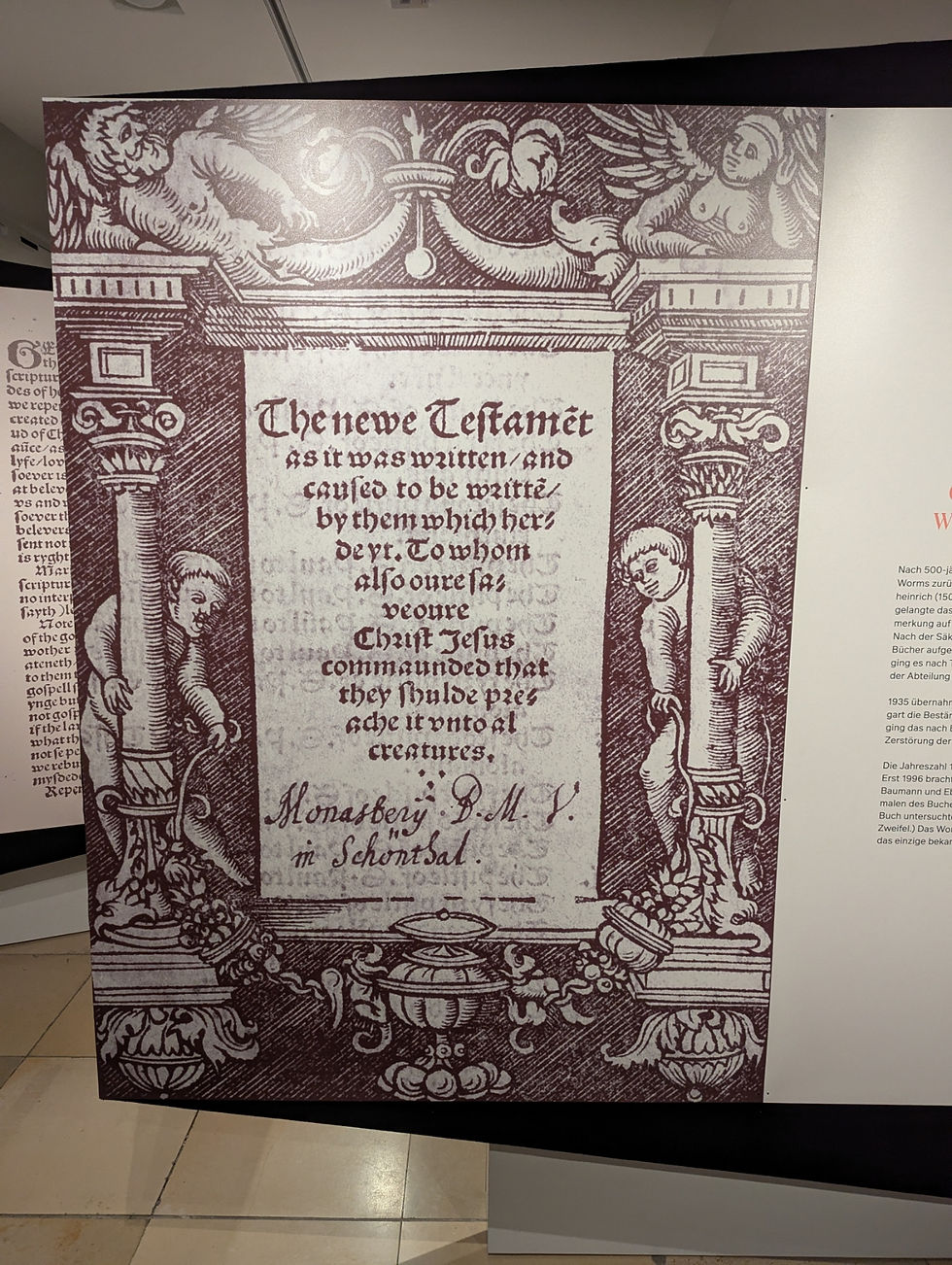
The next day we visited the exhibition itself; immense scholarship and detail were at the core of the special exhibition dedicated to the printing of Tyndale's Bible, making the significance of Worms feel vividly real. The exhibition curated a remarkable collection of documents and printed works telling the story of how Tyndale's forbidden translation rolled off Peter Schöffer's press in Worms in 1526. It was an act of astonishing courage that, along with his Protestant convictions, would ultimately cost him his life.
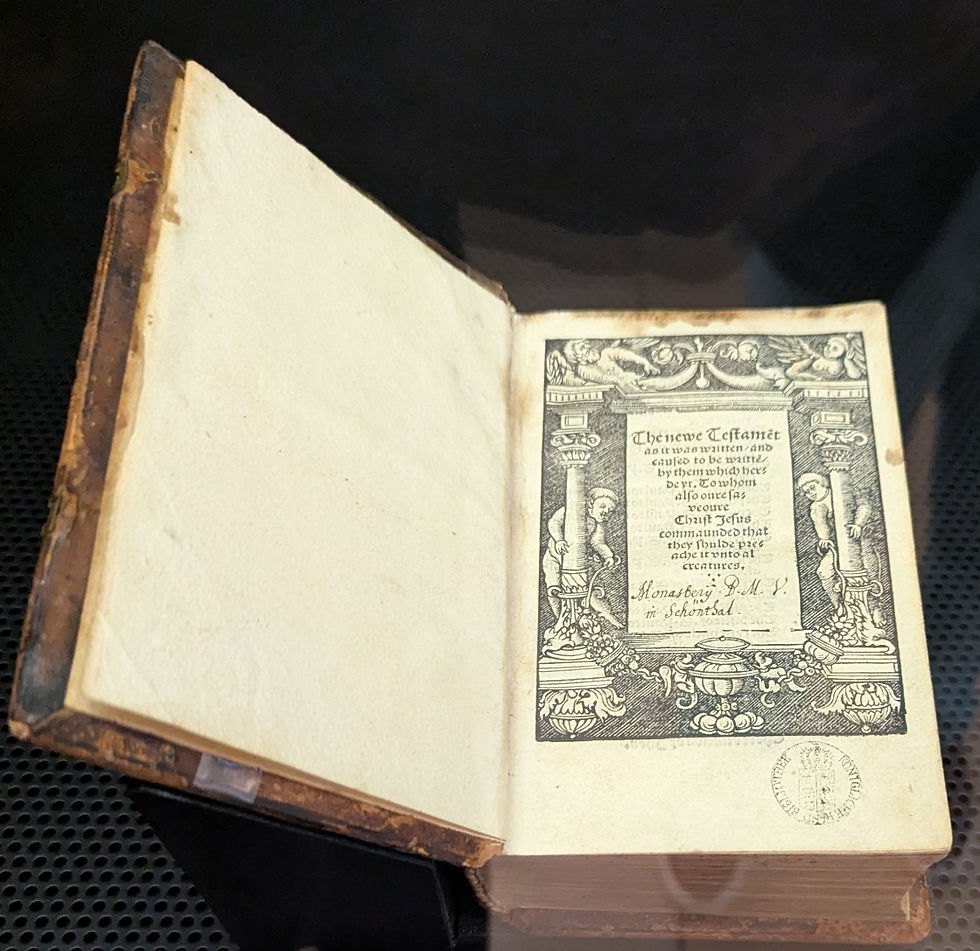
The centrepiece of the exhibition was a copy of Tyndale's New Testament borrowed from Stuttgart. This was no ordinary loan; it was a gesture of scholarly and cultural cooperation that allowed visitors to see, at close hand, the very book smuggled into England and burned by the Bishop of London. To stand before that volume, surprisingly small, unassuming, yet world-changing, was to feel the weight of history pressing upon the present. The typography and paper all spoke of a moment when the printed word became an act of defiance and a gift to the common person. The exhibition also explored the mechanics of early sixteenth-century printing, placing Tyndale's achievement within the broader context of the Reformation and the revolutionary potential of the printing press. Thoughtfully arranged and accessible to scholars and laypeople alike, it succeeded in making the past feel urgent and alive. We left with a renewed appreciation for the physical book as a bearer of ideas, and for Worms as the cradle of the English Bible.
That evening, our contribution to the commemorative programme was a one-hour dramatic performance and historical exploration entitled The Book That Changed the World: William Tyndale and the Battle for the English Bible, presented by Dr Florian Ruths and myself. It was designed not merely as a lecture, but as a vivid, engaging evocation of Tyndale's world, combining narration, slides, and dramatic dialogue. We were astonished and delighted that the venue, the restored and charming Magnuskirche, was packed. The audience must have been around 90, a tribute to the organisers and the interest of the people of Worms in the quincentenary.
In the first half, I traced Tyndale's life: his birth in Gloucestershire around 1494, his brilliant linguistic education at Oxford and Cambridge, his fateful declaration that he would cause "a boy that driveth the plough" to know more Scripture than learned clerics, his flight to Germany, and his clandestine work of translation in Wittenberg, Cologne, and finally Worms. The aim was to highlight the sheer daring of his project: smuggling New Testaments into England, publishing the Pentateuch from the Hebrew, and continuing his revisions even as the net closed around him. The story of his betrayal by Henry Phillips, his imprisonment in the cold castle of Vilvoorde, and his execution on 6 October 1536 is a tale of immense sadness which reveals the harshness of religious controversy.
The second half was the dramatic highlight: an imagined face-to-face debate between Tyndale and Jacobus Latomus, the Leuven theologian and heresy-hunter who interrogated him in prison. Here, the performance came alive as we recreated their theological contest – I tried in my drafting to reveal the intensity and intelligence of the dialogue. Latomus (played by Florian) accused Tyndale (played by me) of pride, of casting the Greek text into "vulgar English," and of undermining the Church's authority to interpret Scripture. Tyndale responded with the conviction that the gospel was "living bread to be broken and shared," that the ploughboy and the serving maid deserved to hear God speak in their own tongue, and that the Church had no right to keep the Word chained.
The dialogue, based upon Latomus's actual writings, drew on real historical debates about language, such as translating ecclesia as "congregation" rather than "church," presbyteros as "elder" rather than "priest," and agape as "love" rather than "charity." It must be remembered that Latomus was no cartoon villain; he genuinely believed that unguided interpretation of the Bible would breed chaos and heresy. Tyndale, for his part, was no reckless radical; he appealed to the Bereans of Acts 17, who searched the Scriptures daily to verify even the Apostle Paul's teaching. The exchange ended with Tyndale's defiance: "Do what you will with my body, for the word will not be bound." The final focus on his dying cry—"Lord, open the King of England's eyes!"—proved to be a profoundly moving conclusion.
What struck me most about the Worms commemorations was how effectively they connected a sixteenth-century struggle to our own age. Tyndale's story is not merely about religion; it is about language, power, and access to knowledge. In an era of information overload, we easily forget that the simple act of translating a book into the language of ordinary people was once a revolutionary act, which could cost a person their life.
The presentation made it clear that Tyndale was more than a martyr; he was a master linguistic architect whose phrasing, such as "let there be light," "the powers that be," "fight the good fight," "my brother's keeper," and "the spirit is willing," still echoes in our daily speech. He introduced words like "atonement," "Passover," "Jehovah," and "scapegoat" to the English language, and an estimated 80 to 90 per cent of the King James Version's New Testament retains his exact wording. I believe to hear that legacy celebrated in Worms, the city where his Bible was first printed, was to understand the deep connection between place, text, and memory.
We left Worms with a profound sense of gratitude: to our lovely hosts, Daniel and Andrea, the city and its people for their generous hospitality; to the exhibition organisers for securing the loan from Stuttgart and curating such a memorable display; and to Oberbürgermeister Adolf Kessel for the honour of attending the annual civic reception, which was a fitting tribute to the values for which Tyndale died.
The quincentenary was not merely a commemoration of a past event. It served as a vital reminder of the battle for the Bible. This was for access to Scripture in the vernacular and for the right of ordinary people to read and interpret the word of God. It was fought and won at great cost. It was a celebration of the enduring power of the printed word to challenge authority, democratise knowledge, and shape the soul of a nation. Worms and St Albans, twinned in history, have done honour to William Tyndale. I am deeply grateful to have been present, and I will carry the memory of that exhibition, that performance, and that city with me for a long time to come.
The Book That Changed the World: William Tyndale and the Battle for the English Bible
15th October, 2026 at 7:00pm, St Peter's Church, St Peter's Street, St Albans, AL1 3HG


Comments