
Why Emotional Attachment Matters in Every Service

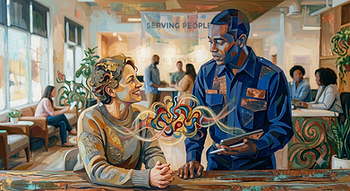
It has long been a concern of mine that, in many areas of life, the services we rely on have lost their emotional attachment to people and their surroundings. I would argue we now live in an age where systems have lost touch with the people they serve; all too often it is “the computer says no”.
Healthcare has become a system of appointments and targets. Planning has become a system of applications and regulations. Social care has become a system of assessments and eligibility criteria. We have built vast, complex frameworks designed to process human needs with the efficiency of a factory assembly line. And in doing so, we have forgotten that the people passing through these systems are not products. They are not numbers. They are not data points. They are human beings, and human beings are not machines.
The most damaging assumption in modern public service is that human needs can be standardised. A bereaved person does not grieve on a predictable timetable. A family facing eviction does not navigate a flowchart. A patient with chronic illness does not fit neatly into a diagnostic category. Yet our systems are designed as if they do. We create pathways, triage them, and treat any deviation as a problem to be managed rather than a human reality to be acknowledged.
This is where emotional attachment becomes not a luxury, but a necessity. Emotional attachment is not about sentimentality. It is about the willingness to see the person behind the case file. It is the recognition that human beings are not interchangeable units of demand but individuals with histories, relationships, fears, and hopes. It is the commitment to respond to those realities rather than merely process them.
In medicine, emotional attachment is the difference between treating a disease and healing a person. The physician who knows her patient's story, who understands his anxiety about the future, who remembers his name, practices better medicine. Research consistently shows that patients who feel seen and heard have better outcomes, not because the treatment is different but because trust enables healing. The system that reduces patients to symptoms and test results is a system that fails at its own purpose.
In planning, emotional attachment is the difference between building housing and building communities. Planners who understand the history of a place, the rhythms of its streets, and the anxieties and aspirations of its residents make better decisions. They know that a housing estate is not just a collection of units but a web of lives. They know that the loss of a local pub is not merely a commercial change but a blow to social fabric. The planning system that treats neighbourhoods as abstract zones of development is a system that creates places where no one wants to live.
In social care, emotional attachment is the difference between administering a service and providing support. The social worker who knows that Mrs Jones used to be a teacher, that she misses her garden, that she is frightened of being alone, can offer care that actually meets her needs. The system that sees only a care package and a budget is a system that leaves people lonely, frightened, and diminished.
Why do authorities resist emotional attachment? Because it is perceived as inefficient. It takes time to listen. It takes energy to remember. It takes courage to care. Systems are designed to process large numbers of people quickly, and emotional attachment slows things down. But the cost of that ‘fake efficiency’ is enormous. We have built systems that are competent at processing and terrible at caring. We have created institutions that appear to meet their targets but lose their humanity.
The alternative is not to abandon systems altogether. We need structures, processes, and accountability. But we need to build those systems with the understanding that they exist to serve people, not the other way around. I remember in my academic life challenging an administrator because the system she implemented was convenient but took no account of student needs. When I argued for a different approach that took student needs into account, I was greeted with "The system doesn't allow that". We need to design pathways that allow for human judgment, not just algorithmic logic. It means training professionals to listen as well as to assess. It means measuring success not just by waiting times and case closures but by the quality of the human interactions that occur within the system.
It also means recognising that emotional attachment is not a weakness. It is a strength. The clinician who cares too much is not less effective; she is more effective because her patients trust her. The planner who loves his city is not less objective; he is more insightful because he understands it. The social worker who feels the weight of her clients' struggles is not less professional; she is more committed because she cannot look away.
Ergonomics has learned to admire coldly efficient systems. Administrators have learned to distrust emotion in professional settings. But in doing so, services have been created that appear efficient but are empty of understanding. The state, sadly, has built organisations that process people but do not care for them. It appears that authorities have forgotten that the purpose of any human service is to serve humans, and that human beings need to be seen, heard, and understood.
The challenge is not to build better systems but to build systems that make room for humanity. It is to create institutions that value emotional attachment as a core competence, not a sentimental indulgence. It is to remember that the people who use our services are not cases, not numbers, not abstractions. They are mothers and fathers, brothers and sisters, neighbours and friends. They are people who have stories, and those stories matter. If we forget that, we are not serving them. We are just processing them. And processing is not the same as caring.


Very true - the failure of emotional intelligence in management is born at great financial cost by society.