
What is Martyrdom?
- Tim Boatswain

- Dec 17, 2025
- 5 min read
Updated: Dec 21, 2025
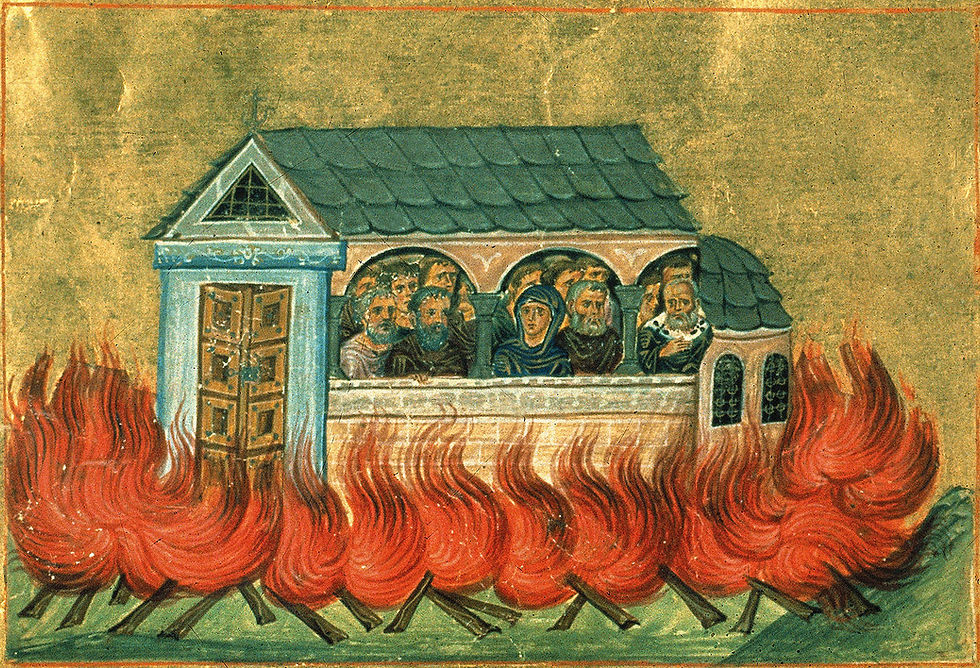
I have been teaching a course on Heresies for St Albans Cathedral, and it is often a sorry tale that ends in cruel death, usually burning at the stake. It seems wherever religion becomes entangled in state politics, anyone who deviates from the proscribed doctrine or rejects the existing hierarchy has to be eliminated in a very gruesome manner as a deterrent to others.
Christians who refused to recognise the gods of the Roman Empire were subject to extermination, and the standard trope is of them being thrown to the lions in an amphitheatre as a public spectacle. Within the Christian community, those who died for their religious belief became known as martyrs from the Greek word μάρτυς, meaning ‘a witness’. These martyrs, men and women who died for their religious faith, were lauded as heroes and heroines: examples of believers who were recognised as having an exceptional degree of holiness, which made them close to God. Once Christianity became the state religion, those who had died for their faith were hailed as martyrs and were given the title of Saint (Latin, sanctus = holy). They were worthy of public recognition as a model for others.
For Christianity, its martyrs were mostly passive, and it was the authorities that inflicted martyrdom upon deviant individuals. However, there were, and are, so-called martyrs, for example, in the Muslim religion, who actively seek out martyrdom in the belief that they are carrying out God’s will by killing infidels and then sacrificing their own lives, so that their 'holy death' will hurry them toward the rewards of Paradise. The recent acts of terrorism across the world in the name of Islam have motivated me to take a closer examination of martyrdom.
The late Christopher Hitchens, known for denouncing religions, perceived martyrdom as a totalitarian tool for control. He argued that religions manipulate suffering for their own hierarchical power by exploiting the ignorant. Is martyrdom, therefore, to be admired as demonstrating, through an act rather than just words, a true conviction in a belief, or is it an extreme manipulation of the gullible?
It is fair to say that martyrdom is not easy to understand in the modern era. At a time when the Western World values comfort and self-preservation, the idea of a violent death for faith seems bizarre. However, for some religions, even now, martyrdom is not seen as a tragic end, but a moment of triumph. It has been argued that it is where “human fragility meets divine truth, transforming the body’s destruction into the soul’s ultimate affirmation.” Why does martyrdom hold such weight among some religions?
For the early Church, the Christian faith existed in an essentially hostile environment, so the voluntary surrender of your life was the ultimate commitment to your religion. The martyrs’ deaths were seen as a belief in the reality of the Resurrection. Martyrs don’t just declare their belief is worth dying for but they demonstrate it by making an abstract conviction into a concrete physicality through their death.
One anthropological view is that martyrdom symbolically performs a stunning spiritual reversal: it takes humanity’s deepest fear, our annihilation, and defeats it on behalf of the community. It is showing, though, of course, not proving, that death is not the end. The martyr, it is argued, liberates the faithful from the world’s ultimate destruction of the self. In the Roman arena, as chronicled in Christian ‘acta’, martyrs often faced torture with a serenity that unnerved their persecutors. Such ‘post hoc’ propaganda declared this was not madness, but was proof of a higher reality. Their courage became a collective possession, a lived example that the bonds of faith are stronger than the instincts of the flesh.
In some traditions, martyrdom is the ultimate act of imitation of the divine. For Christians, it mirrors Christ’s sacrifice on the cross. In Shia Islam, the martyrdom of Hussain at Karbala (CE 680 ) is a core element in a stand against tyranny. For Sikh Gurus, it embodies fearless truth (Sat) against oppression. This mimicry often comes with a promise of unparalleled reward. In Islamic theology, the martyr (shahid) is cleansed of sin and granted immediate entry to Paradise. In Catholicism, martyrdom is considered a “baptism by blood,” conferring sainthood. This promise transforms death from a meaningless exit into a glorious, and, paradoxically, glamorous promotion, the ultimate shortcut to eternal bliss and honour.
It is argued that the martyrs’ faith and suffering create and solidify group identity. Their stories become foundational myths, binding the community together in shared memory and purpose. The martyrs of the Sikh faith, like Guru Tegh Bahadur, who was executed for defending religious freedom, are central to the Sikh ethos of resistance and righteousness (Dharma). Their deaths are not merely historical events but living inspirations, commemorated annually in powerful rituals that reinforce “who we are” and “what we stand for.” The martyr becomes a permanent, uncompromising standard against which the faith of later generations is measured. There is no more fundamental sacrifice than giving up your life for your faith and your community.
Therefore, in some societies, martyrdom is perceived as an immense ethical and political force. It exposes the moral bankruptcy of the persecutor, turning brute power into spiritual weakness. The martyr, often a lowly and powerless individual, becomes a potent symbol of resistance. In the 20th century, figures like Dr Martin Luther King Jr. (whose martyr-like death was framed within a Christian narrative) or the self-immolating Buddhist monks of Vietnam used the symbolism of martyrdom to sway global public opinion and galvanise movements. It is the weapon of the ostensibly powerless, a means of asserting moral victory in the face of physical coercion and defeat.
However, as the rational human being can see, the emotional power that makes martyrdom sacred within a tradition makes it vulnerable to manipulation. The line between martyr and terrorist, between sacred witness and fanatical suicide, often lies in the eye of the beholder. One Muslim community’s martyr is another’s society’s terrorist. Too often, religious authorities have failed to prevent the glorification of nihilistic violence, the massacre of the innocent, and the exploitation of the vulnerable.
In the end, martyrdom, for theocratic societies, remains potent because it speaks to a fundamental human longing: for a meaning so powerful it can conquer humanity’s deepest fear of mortality, that is, the total obliteration of the self. It is the extreme point where faith moves from theory to irrevocable act, leaving an indelible mark not just on history, but on the very conception of what it means to believe. For science, it is an irrational act of meaninglessness; for the faithful, it is the ultimate salvation.


Comments