
Are we all Romantics, and is that a problem?
- Tim Boatswain

- Jun 2
- 3 min read
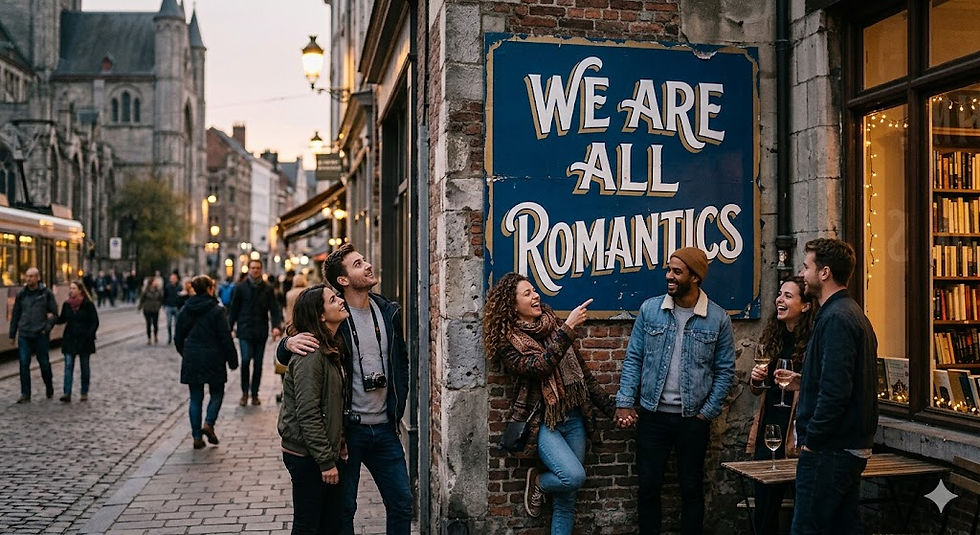
Recently, I gave a talk at the Cathedral where I claimed we are all Romantics, why and is this true? In one sense, the answer is yes: we are all Romantics now. The movement that began in the late eighteenth century as a rebellion against Enlightenment rationalism and industrialisation has seeped so deeply into our cultural water that we no longer recognise it as a historical phenomenon. It is simply the way we think.
Consider the evidence. We prize authenticity above almost everything. We want to "find ourselves", to express our unique inner truth, to live a life that feels genuine rather than imposed. This is a Romantic ideal, rooted in the belief that the individual self is a deep well of meaning. We celebrate the rebel, the outsider, the brooding hero who defies convention. From rock stars to tech entrepreneurs, our cultural icons are often versions of the Byronic hero: passionate, tortured, and in conflict with the world. We love wild landscapes. We hike mountains, walk coast paths, and speak of nature as a source of spiritual renewal. This, too, is Romantic. The Wordsworthian notion that nature can heal and teach us is now a commonplace of environmentalism and mental well-being.
We are suspicious of pure reason. When someone says "you are being too emotional", we are more likely to defend emotion as a legitimate form of knowledge than to apologise for it. The Romantic privileging of feeling over logic has become, in many contexts, the default position. And we believe that art should move us, not merely instruct or decorate. The idea that a painting, a poem, or a piece of music should be judged by its emotional impact is Romantic to its core.
So yes, we are all Romantics. But is that a problem?
The Romantic inheritance has brought immense goods. The belief in individual rights, the celebration of cultural difference, the environmental movement, the validation of emotional life, the insistence that ordinary people have access to beauty and meaning – all of these flow from Romanticism. A world without Romantic values would be colder, more mechanistic, and less hospitable to human flourishing.
But there are dangers. The Romantic emphasis on authenticity can tip into solipsism: the belief that my feelings are the only truth that matters. When everyone claims to be a unique, misunderstood genius, collective action becomes difficult. The Romantic celebration of the outsider can romanticise self-destruction and excuse bad behaviour. The Byronic hero is compelling in fiction; in real life, he is often simply a mess. Yes, we have all met these ‘heroes’ and wanted to throttle them!
The privileging of emotion over reason can lead to a culture in which feelings are treated as facts, and in which uncomfortable truths are dismissed because they do not feel right. The Romantic suspicion of institutions and authority has fuelled a corrosive distrust of expertise, science, and democratic governance. And the Romantic love of the wild, for all its benefits, can also encourage a disdain for the ordinary, the everyday, the built environment that most of us actually inhabit.
The deeper problem is that Romanticism is better at critique than at construction. It is brilliant at diagnosing what is wrong with a mechanised, rationalised, disenchanted world. It is less good at offering a sustainable alternative. A Romantic rebellion can be exhilarating, but it rarely builds a school, a hospital, or a functioning political system. And then we became angry at the lack of progress, but we are part of the problem because our expectations are built upon an unrealistic romantic promise!
We do not need to abandon Romanticism. That would be impossible in any case. But we might need to balance it with something older: a sense of duty, a respect for institutions, a willingness to compromise, an acknowledgement that reason has its place alongside feeling: I know I sound like Socrates, who railed at the younger generation. The Romantics were right that there is more to life than what can be measured. But they were wrong to think that measurement has no value at all.
So are we all Romantics? Largely, yes. Is that a problem? It is only a problem if we forget that Romanticism is one truth among many, not the whole truth. The challenge is to hold the Romantic impulse in tension with other, older values: duty, reason, community, and the patient, unglamorous work of building a world that can hold us all. That is not an easy balance. But it is the balance we need.


Comments