
A Blue Plaque Honours Holmes Winter

Updated: Sep 9

An important local artist was commemorated today (5th September 2026) with the official installation of a blue plaque for Holmes Winter at 9 Alma Road, St Albans. The ceremony not only honoured the artist himself but also celebrated a remarkable friendship with fellow artist Frederick Kitton, which was a partnership that helped preserve a record of St Albans' architectural heritage for future generations.
The installation was formally introduced by Professor Tim Boatswain, Chair of Blue Plaques St Albans, who provided an overview of Winter's life and contributions to the community. Winter (1851–1935) was a distinguished local watercolourist, etcher, and draftsman who trained at the Norwich School of Art. He came to St Albans around 1880 to draw, paint, and teach, and his evocative landscape paintings and architectural studies captured the essence of Hertfordshire's historic charm during a period of significant change.
Number 9 Alma Road marks the building where Winter lived, as recorded in the 1911 census, and worked during a key creative period of his career. The plaque now stands as a permanent tribute, ensuring that his contribution to local culture and visual heritage continues to be recognised by residents and visitors alike.
Central to Winter's story, and to the preservation of St Albans' historic buildings, was his friendship with Frederic George Kitton (1856–1904). The two were boyhood friends from Norwich who studied together and, as young men, travelled the country on walking tours. Both were talented artists, but while Kitton went on to become a renowned wood-engraver, author, and illustrator, who is best known for editing and illustrating the works of Charles Dickens, Winter devoted himself to capturing the vanishing architectural heritage of St Albans. However, the two artists worked together, producing illustrations of old buildings they both feared would be torn down for the sake of modernity.
Winter's book, The Last of Old St Albans, featured one hundred etchings of the town's oldest buildings. The project served two vital purposes. As a historical record, it captured buildings that were at risk of being lost, preserving their appearance for posterity. As an act of advocacy, Winter's purpose was not solely commercial, as he wanted to alert people to the danger many of the city's valuable old buildings faced, making the book as much a heritage-campaigning tool as an artistic project.
Winter's etchings were produced in a strictly limited edition of just twenty-five copies, with the plates destroyed after printing to ensure their rarity. His work captured buildings that Kitton was campaigning to save, many of which were subsequently demolished. Though Kitton's drawings were technically more accurate, Winter's etchings are widely considered more atmospheric, which is a quality that has only enhanced their historical value.
Together, the two friends created an invaluable visual record of St Albans as it stood at the turn of the century. Kitton became much more active in attempting to preserve the buildings he had previously recorded, becoming one of the city's earliest and most passionate conservation advocates: for example, saving The Gables in Market Place from demolition – Blue Plaques St Albans has installed a blue plaque to honour Kitton on that building.
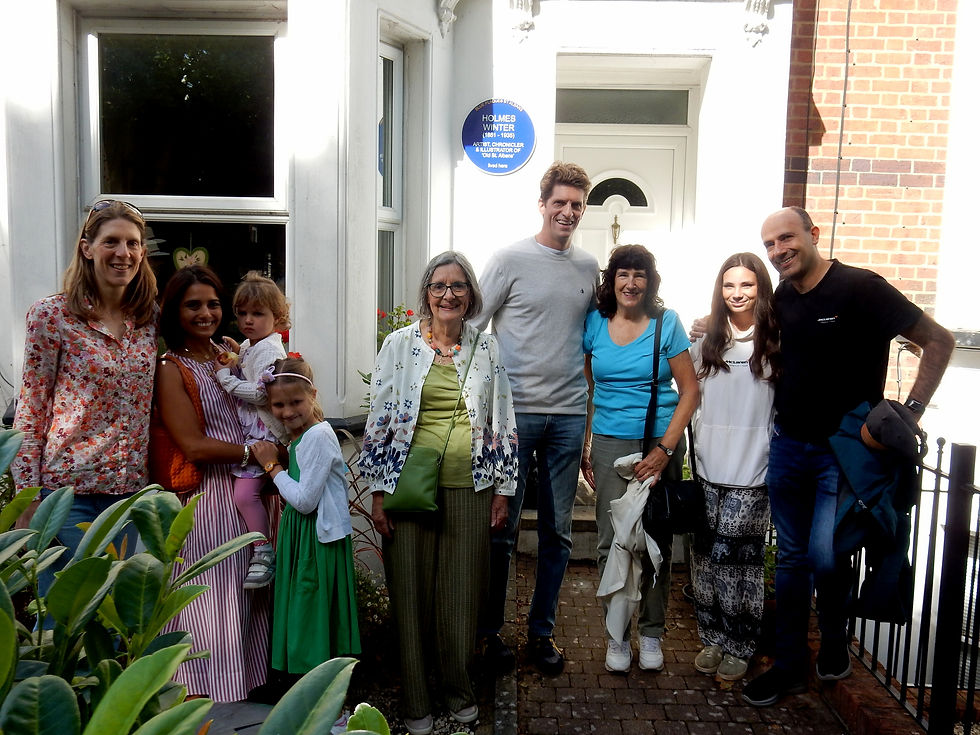
The Holmes Winter plaque on 9 Alma Road was sponsored by Liz Holiday, who attended the ceremony with members of her family. Her late husband, Malcolm Holiday, was an enthusiastic collector of Winter's works and a member of the St Albans and Hertfordshire Architectural and Archaeological Society. Malcolm acquired his copy of The Last of Old St Albans at an antique sale, and it appears to have been hand-coloured by Winter himself. Some pieces from Malcolm's collection were featured in an exhibition at St Albans Cathedral in August 2024.
The Griffin family, who are currently tenants of the property at 9 Alma Road, also joined the proceedings to mark the occasion at their residence.

The presence of some of Winter's descendants added a deeply personal dimension to the installation. Their attendance, alongside the Holiday and Griffin families, created a strong sense of continuity and community, which is a fitting tribute to Holmes Winter, whose shared vision with Kitton helped ensure that St Albans' architectural heritage would not be forgotten.
Liz Holliday kindly offered a few words of thanks to Blue Plaques St Albans, after which the Chair thanked all those involved in making the installation possible. The event concluded with attendees reflecting on the legacy of Holmes Winter and his friend Frederic Kitton, and the enduring importance of remembering what has been lost, so that what remains might be saved.


Comments